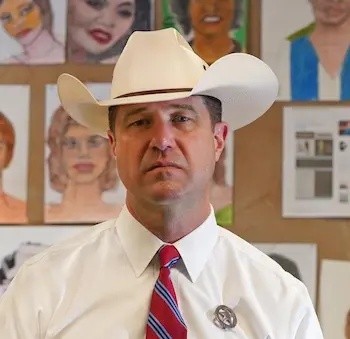
James B. Holland Biography
James B. Holland, a retired Texas Ranger, has become one of the most notable figures in contemporary criminal investigation thanks to his extraordinary ability to elicit confessions from some of the nation’s most hardened offenders. His work has influenced law enforcement interrogation practices, generated widespread media attention, and now heads a high-profile true-crime television series.
Early Life and Law Enforcement Beginnings
James was born and raised in Polo, Illinois, United States. He graduated from the University of Louisville in 1993. He immediately started his career in law enforcement. This would eventually take him to the front lines of some of the toughest investigations in the United States.
In 1995, Holland joined the Texas Department of Public Safety as a highway patrol trooper. His early career included roles that showcased his versatility, including providing security for then-Texas Governor George W. Bush and during Bush’s presidential campaign.
Becoming a Texas Ranger
Holland advanced in the Texas Rangers, an elite investigative division of the Department of Public Safety. The Department is well known for handling major crimes, including homicides and serial offenses. As a Ranger, he quickly developed a reputation for his skill in interviews and interrogations. He mixed psychological insight with meticulous preparation to gain cooperation from suspects who had resisted conventional investigative techniques.
While his exact methods have sparked debate among criminal justice scholars and practitioners, there is no dispute that his results have been remarkable, most notably in his work with one of the most prolific serial killers in U.S. history.
The Samuel Little Case: A Landmark in Confession Work
In 2018, Holland gained national recognition for his involvement in convincing Samuel Little, a convicted murderer, to confess to 93 separate homicides. The highest known number of confirmed killings by any serial killer in U.S. history. Over the course of extensive interviews, Holland’s skillful rapport-building and patient approach drew out details that linked Little to dozens of cold cases across multiple states.
The confessions not only helped bring closure to families of long-unsolved murders but also positioned Holland as a subject-matter expert on interviewing resistant subjects. His work helped law enforcement agencies match Little’s admissions to physical evidence and missing persons cases, providing a rare breakthrough in cases that had languished for years.
Media Presence and Public Interest
Holland’s unique investigative approach has attracted significant media coverage over the years. In 2019, 60 Minutes featured him in an episode titled “The Ranger and the Serial Killer,” introducing a wide audience to his interrogation philosophy and his role in the Little case.
His expertise has also led to appearances on crime documentary programs like 48 Hours, where his contributions to solving cases such as the murder of Jackie Vandagriff were highlighted.
Most recently, Holland’s career has been dramatized in the Investigation Discovery series Killer Confessions: Case Files of a Texas Ranger. Premiering in January 2026, the show takes viewers behind the scenes of a variety of cold cases, illustrating how Holland’s interrogation methods and psychological insight helped crack seemingly unsolvable crimes.
Controversy and Debate Over Interrogation Tactics
Despite his successes, Holland’s methods have not been without scrutiny. Some legal scholars and criminal justice advocates argue that certain interrogation tactics, particularly those involving psychological pressure or deception, can risk eliciting false confessions. Podcasts such as Smoke Screen: Just Say You’re Sorry have examined specific cases where questions have been raised about the reliability of confessions obtained under Holland’s direction.
Debate within law enforcement and academic circles continues over the balance between effective interrogation and the protection of suspects’ rights. Nevertheless, Holland’s defenders point to the number of cases resolved and the comfort brought to grieving families as evidence of his positive impact.
Legacy and Ongoing Influence
James Holland remains an influential voice in criminal investigation and interrogation training. Law enforcement agencies across the country have sought his insights, whether through formal seminars or through his televised work. His career underscores the evolving nature of detective work in the modern era — where psychology, patience, and persistence often matter as much as physical evidence.
Through his contributions to criminal justice and public understanding of complex investigations, Holland’s impact will likely resonate in both law enforcement practices and popular culture for years to come.


